Fra Aumgn
WHAT IS HERMETIC SCIENCE?
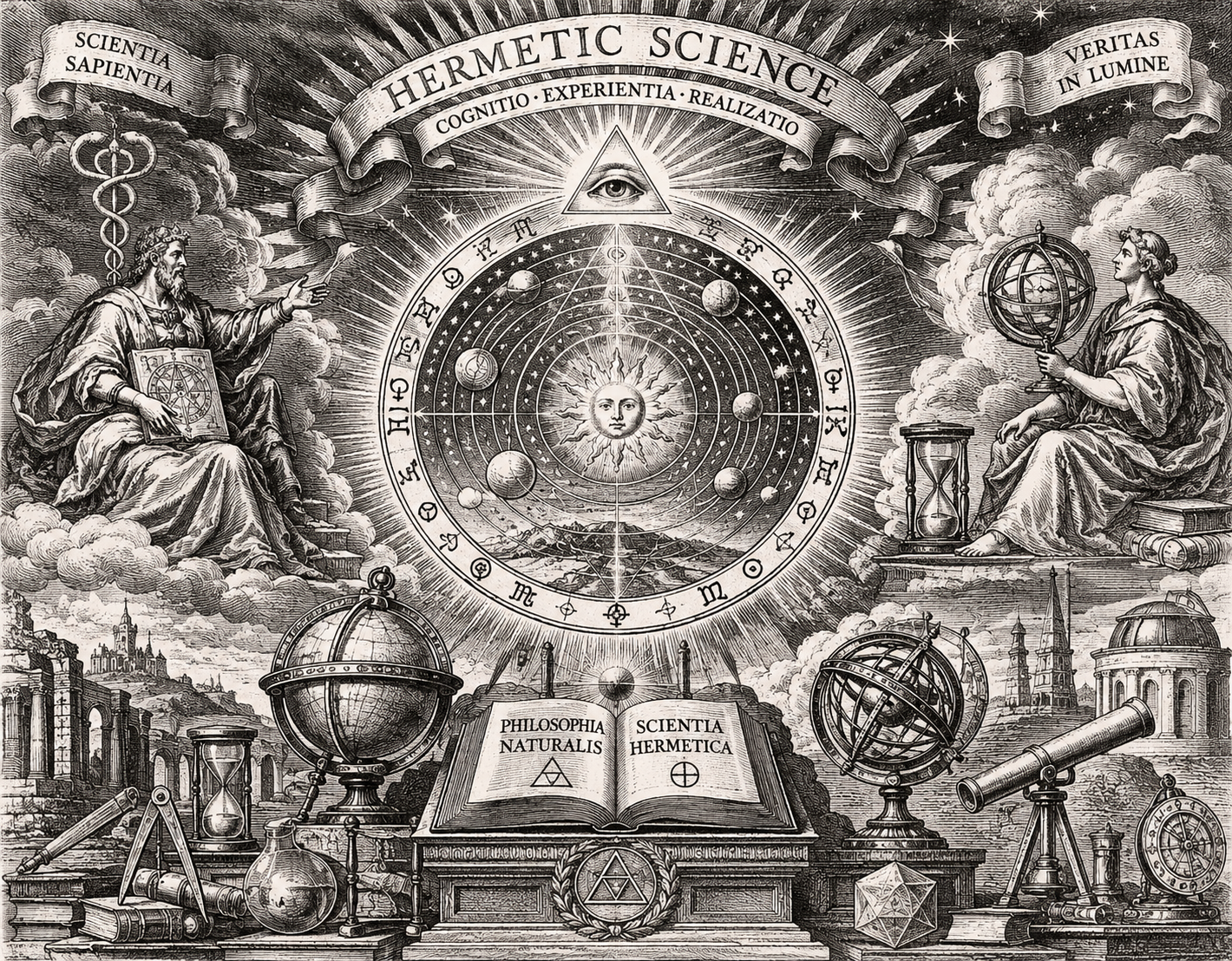
Συνουσία
Throughout history, the relationship between Hermeticism and Science has remained fluid.
Hermeticism emerged in Late Antiquity and became a mode of thought characteristic of the Western tradition. Originally a phenomenon of the culture of myth, it developed within this cultural framework, yet did not conceptually belong to it. From this culture Hermeticism inherited an artistic language; however, its form did not serve itself, but expressed knowledge whose expansion required immersion in Being and reflective awareness.
Science, too, originally took shape within the culture of myth, yet its emergence in the modern era required a break with artistic language, giving rise to a discrepancy between Hermeticism and Science. At the same time, there was no essential divergence between them—knowledge of the universe had always remained their common aim.
Owing to inner similarity and outward difference, they were drawn together and driven apart over a long period. Like the serpents of the caduceus, Hermeticism and Science converged during the Renaissance and diverged during the Enlightenment, converged again in the Romantic era, and diverged once again in the contemporary era.
At the turn of the nineteenth and twentieth centuries, attempts were made to unite them by occult researchers (Papus [Gérard Anaclet Vincent Encausse], Theodor Reuss [Albert Karl Theodor Reuss], Giuliano Kremmerz [Ciro Formisano], and others), who relied on the expression “Hermetic science”; however, their efforts proved futile—to this day it remains a metaphor.
At the beginning of the twentieth century, the scientific worldview was strongly influenced by objectivism, whose initial assumptions did not coincide with Hermetic ones. Consequently, the concept could not be developed—the conditions allowing for its adequate grounding had not yet taken shape.
Today, objectivism has not exhausted itself, yet it has ceased to define the boundaries of science. Contemporary philosophy and physics have at their disposal arguments and facts that call into question both the objectivist picture of reality and the independence of its observer.
The fragility of foundational assumptions reveals objectivism as an idealist notion with an irrational source, whose claims to realism and universality are ambiguous. This gives occasion to turn to philosophy in search of an alternative epistemology and to pose anew the question of Hermetic science.
Παιδί
Hermetic science is relevant as a formula bringing together initiatic and scientific knowledge. Initiatic knowledge requires demythologization and intellectual interpretation, while scientific knowledge requires elevation to metaphysics and orientation toward individual realization.
It is essential that Hermeticism and Science yield a synthesis rather than a mixture of mutually contradictory components. Accordingly, they must enter into a reaction that transforms them into a new concept, one that cannot be reduced to a set of their initial qualities.
This requires the union not of forms, but of essences; therefore, the principal task is to separate the gross from the subtle—with caution and great skill. To accomplish this, one should clarify the conceptual plane that makes it possible to combine them without contradiction.
Hermetic knowledge, by its characteristics, is chemical, organic, vivid, plastic, realistic and fantastic, multifaceted and multidimensional. It is akin to communion, in which the assimilation of a part precedes the comprehension of the whole, just as knowledge of an attribute makes it possible to apprehend the phenomenon to which it pertains.
Hermetic knowledge arises through lived experience and is not reducible to description—its theory demands experience and insight. The more refined and multidimensional the individuality, the more subtly and profoundly this knowledge reveals itself in its beauty, which radically distinguishes Hermeticism from aesthetics with its cult of form without content, and from science with its pursuit of truth regardless of beauty.
When Hermetic knowledge is exhausted, it remains open for interpretation on new planes. At the same time, the nature of these planes is such that the further the knower advances, the fewer possibilities of understanding remain.
Therefore, when Hermetic knowledge discovers its own horizon, what remains is either to begin everything anew, clarifying everything again and again through doubt, or to withdraw into Blackness, in which clarity as a given is complete and science ceases to be possible.
Scientific knowledge, by its characteristics, is speculative, formalized, objectified, invariant, factual, organized by subject area and unambiguous. It requires definition, which gives an idea not of a part that allows one to foresee into the distance, but of a whole that submits to reason and becomes complete.
Scientific knowledge is subject to abstract understanding, reduces to description, and is transmitted through text. What matters is the objectified medium of transmission, rather than the individuality of the knower; this is what makes scientific knowledge socially reproducible.
Scientific knowledge is measurable, verifiable and systematized in explanations that do not admit alternative interpretation. At the same time, it is progressive, so scientific explanations are capable of becoming outdated, turning out erroneous and being discarded.
The difference in the specificity of Hermetic and scientific knowledge brings us to the question of its form adequate to Hermetic science. Inquiry into it allows us to draw general conclusions.
PRINCIPLES OF HERMETIC SCIENCE
1. External Expression. It is certain that the knowledge of Hermetic science must not remain purely internal, but must find external expression in articulated statements. In order to bring it beyond the limits of private conditioning, it must be rendered into text.
2. Rejection of Artistic Language. Such a form of utterance is unsuitable for Hermetic science, unlike Hermeticism, because the cognitive function is not the defining function of this language, but coexists with others—aesthetic, historical, cultural. This prevents it from fully developing in accordance with its intended function and curtails the possibilities of criticism. Turning away from artistic means of expression implies a formal rather than an essential break, which is absent on planes where science is art, its concepts are symbols, and its theories are conceptual works in a specific style.
3. Openness to Criticism. The utterances of Hermetic science must have an intellectually grounded interpretation, open to criticism capable of exposing and overcoming problems conditioned by the limitations of one’s perspective—its susceptibility to illusion, its situational character, and its tendency to overreach. Openness to criticism implies rationalization, which should be regarded not as a dubious assumption of the rationality of Being, but as an accessible means of explaining a reality that is more complex than reason and surpasses its horizon.
4. Identity of the Individual and the Universal. Hermetic science must proceed from the essential identity of the individual and the universal, an identity that gives rise to an insightful vision of the general order. Such a stance makes it possible to move past objectivism as a paradoxical form of self-negation and subjectivism as a form of relativism mired in particularity. It ensures not the exclusion and alienation of the subject, but, on the contrary, their full inclusion in the process of cognition, directed not only at the growth of knowledge, but also at the subject’s own transformation through understanding.
5. Solipsism. Hermetic science, as a conception of the general order, rests upon an alliance of conventionalism and solipsism. Since a human being is incapable of stepping beyond the limits of their own individual consciousness, their vision is subject to explanation and conventional evaluation. Expert recognition does not cancel the solipsistic essence of this vision. In its advanced form, it may retain adequacy while becoming inaccessible to the understanding of others, taking the form of an individual perspective. Accordingly, the further Hermetic science goes, the more clearly it reveals itself as a transcendental art whose sole genuinely real foundation is solipsistic.
6. Unity of Cognition and Realization. For Hermetic science, cognition means realization, and realization means cognition. The object of Hermetic science is reality; its subject is the human being.
7. Harmony of Feeling and Intellect. The knowledge of Hermetic science must extend from the experience of concrete reality to understanding, from lived experience to concept, from perception to intellect and back again, whereby it is called to overcome problems generated by the limitations of the senses, the limitations of speculative thought, and their disharmony.
8. Distinction Rather Than Opposition. The knowledge of Hermetic science proceeds from distinction, leading into a complex and multifaceted reality in which nothing stands in opposition to anything else, though opposition may be applied as an abstract means of reduction when useful.
9. Unity of Disciplines. Hermetic science may be divided into branches, yet fundamentally it integrates them, since all branches to one degree or another reflect one another and interpret Being in multiple ways.
10. The Limits of Conclusions. The knowledge of Hermetic science must strive toward stable conclusions, reliable within particular horizons. There are no grounds to suppose that the universe, which has never been known absolutely or exhaustively, is governed by universal laws; therefore, any conclusions about reality have a limited rather than unlimited scope of validity.
11. Truth as a Means. The pursuit of truth for Hermetic science is not an end, but a means—a paradoxical intentional stance sustaining cognition as a process. Establishing what is reliable at a particular stage of this process does not mean that its validity will persist beyond that stage; therefore, truth can lose its validity and even turn into falsehood as the cognitive process unfolds. Hermetic science is not concerned with seeking truth for truth’s sake—it seeks truth for the sake of the expansion of light, whose ray illuminates the path of human life through the darkness.
© Fra Aumgn, Basileus O.T.O.
Originally published in 2021. Translated into English in 2026.